
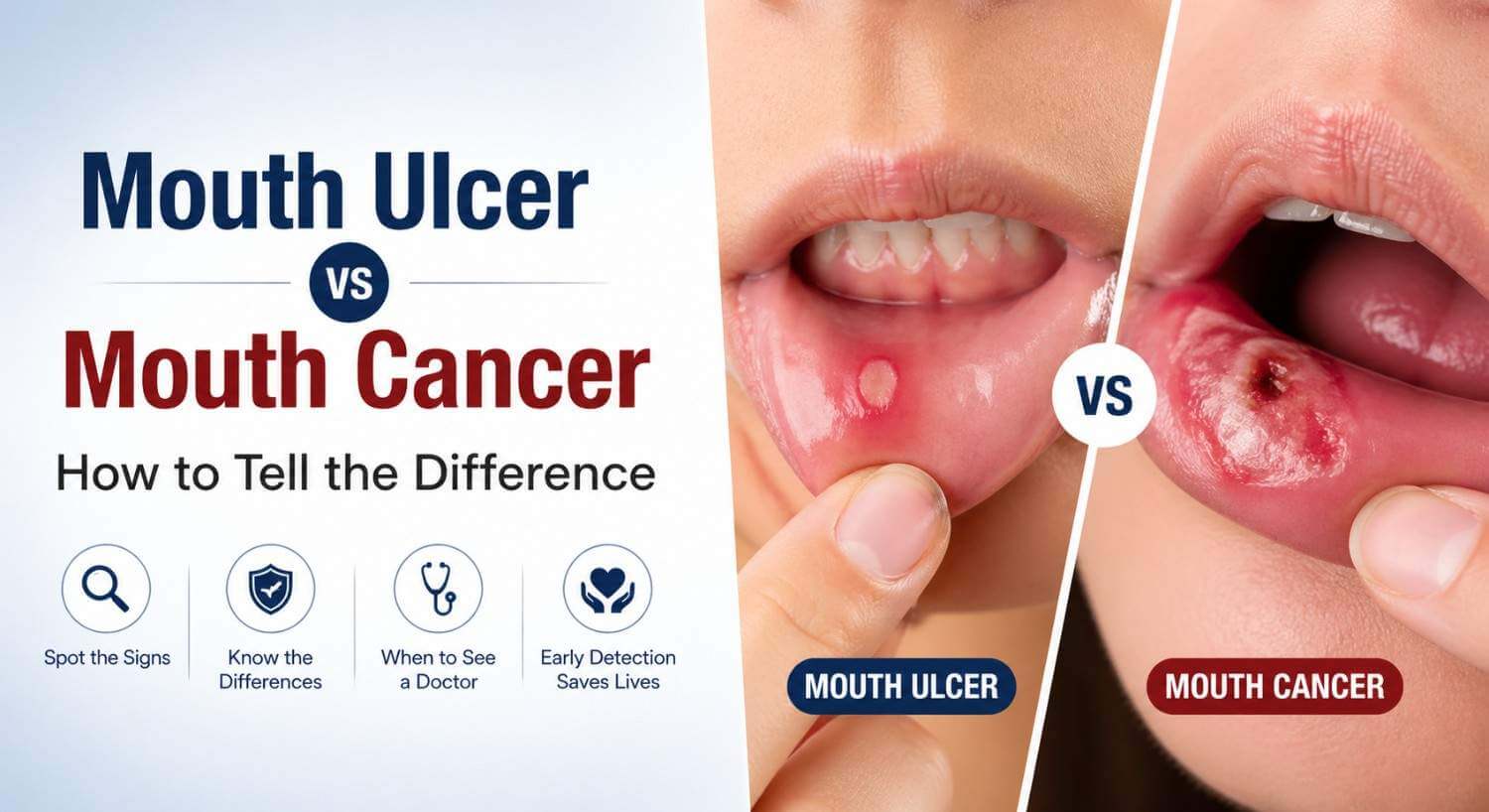
Almost everyone gets mouth ulcers from time to time. They are common, usually harmless, and tend to heal on their own within a week or two. But in a country like India, where oral cancer rates are among the highest in the world, a persistent mouth ulcer can sometimes be the first sign of something more serious.
If you are looking for the Best mouth cancer surgeon in Ahmedabad, consulting an experienced specialist like Dr. Supreet Bhatt can help you identify warning signs early and receive the right treatment at the right time.
Understanding Regular Mouth Ulcers (Aphthous Ulcers)
Common mouth ulcers, medically known as aphthous ulcers, affect up to 20 percent of the population at any given time. They are small, round or oval sores that appear on the soft tissues of the mouth — the inner cheeks, lips, tongue, or the floor of the mouth.
They are usually white or yellowish in the centre with a red border around them.
Key Characteristics of a Regular Mouth Ulcer
- Significant pain or burning sensation (especially when eating spicy or acidic foods)
- Small size (usually less than one centimetre)
- Clearly defined round or oval shape
- Healing within 7 to 14 days without treatment
- Tendency to recur in the same or different locations
Common Causes of Regular Mouth Ulcers
- Accidental biting of the cheek or tongue
- Irritation from sharp teeth or poorly fitting dentures
- Stress and lack of sleep
- Vitamin deficiencies (especially B12, iron, and folic acid)
- Hormonal changes
- Acidic or spicy foods
When a Mouth Ulcer Could Be Cancer
A cancerous mouth ulcer behaves very differently from a regular one. Here are the warning signs that should prompt you to see a doctor immediately:
1.It does not heal within three weeks.
This is the single most important red flag.
If a mouth ulcer has been present for more than two to three weeks and shows no sign of healing, it must be evaluated by a specialist.
This rule applies regardless of whether the ulcer is painful or painless.
2.It is painless.
This surprises many people, but early-stage cancerous ulcers are often painless or cause only mild discomfort. Regular ulcers, by contrast, tend to be quite painful. A painless ulcer that persists is actually more concerning than a painful one that heals quickly.
3.It has raised, rolled, or hardened edges.
When you run your tongue or finger along the edge of a cancerous ulcer, you may feel that the border is raised, firm, or rolled outward. A regular ulcer tends to have flat, soft edges.
4.It bleeds easily.
Cancerous ulcers may bleed when touched, brushed, or even spontaneously. Regular ulcers rarely bleed unless you traumatise them directly.
5.It is growing in size.
A regular ulcer stays the same size or gets smaller over time. If an ulcer is slowly increasing in size over weeks, this is a strong warning sign.
6.It is located in a high-risk area.
While regular ulcers can occur anywhere in the mouth, cancerous ulcers are most common on:
- The lateral (side) border of the tongue
- The floor of the mouth
- The buccal mucosa (inner cheek), especially in the area where tobacco or gutka is placed
7. There is a lump in the neck.
If you notice a painless lump on either side of your neck along with a non-healing mouth ulcer, this suggests the possibility that cancer has spread to a lymph node.
The Indian Context: Why This Question Is So Important Here
India has a unique oral cancer profile due to the widespread use of smokeless tobacco products. Millions of people across the country chew gutka, khaini, zarda, mawa, and pan masala daily.
These products contain carcinogens that directly damage the lining of the mouth over many years.
Many users develop chronic mouth sores and irritation that they learn to live with, assuming it is a normal consequence of their habit. This normalization of mouth problems is dangerous because it can mask the early signs of cancer.
Additionally, there is a cultural tendency in many parts of India to first try home remedies — applying honey, glycerine, or herbal preparations to mouth ulcers — before seeing a doctor.
While these remedies are fine for regular ulcers, they can lead to dangerous delays when the ulcer is actually cancerous.
What Should You Do?
If you have a mouth ulcer that has not healed within three weeks, visit an ENT specialist or a head and neck cancer surgeon. If you are in Gujarat, consulting the Best mouth cancer surgeon in Ahmedabad, such as Dr. Supreet Bhatt, can help ensure timely diagnosis and appropriate treatment.
Do not wait for the ulcer to become painful or to grow larger. The doctor will examine the ulcer and, if it looks suspicious, will recommend a biopsy. A biopsy is a simple, quick procedure done under local anaesthesia.
A small piece of tissue is taken from the ulcer and sent to a laboratory for examination under a microscope. The results are usually available within three to five working days.
If the biopsy confirms cancer, the good news is that early-stage oral cancer has an excellent cure rate. Treatment for a small cancer detected early may involve only a minor surgical procedure, often without the need for radiation or chemotherapy.
About Dr. Supreet Bhatt
Dr. Supreet Bhatt is recognised as one of the Best mouth cancer surgeons in Ahmedabad, He has different specializations such as diagnosing and treating oral and head & neck cancers. He has a lot of experience managing mouth cancers no matter the level. Dr. Supreet Bhatt has a special focus on early case detection, proper diagnosis, and treatment planning that is center based on the prognosis goals.
Individuals who have endured long-standing mouth ulceration, who have oral lesions and who have any worrying symptom of cancer of the mouth, are encouraged to consult professional help as early as possible.
Key Takeaway
Most mouth ulcers are harmless and will resolve on their own. But the one that does not heal — the one that lingers beyond three weeks — deserves your attention.
Do not let fear, stigma, or busy schedules prevent you from getting it checked. A five-minute examination by a specialist can either put your mind at ease or catch a problem at its most curable stage.
Either way, you win.

About the Author
Dr. Supreet BhattHead and Neck Cancer Surgeon and Thyroid Surgeon, Senior Consulatent Zydus Cancer Center
View all articles →