
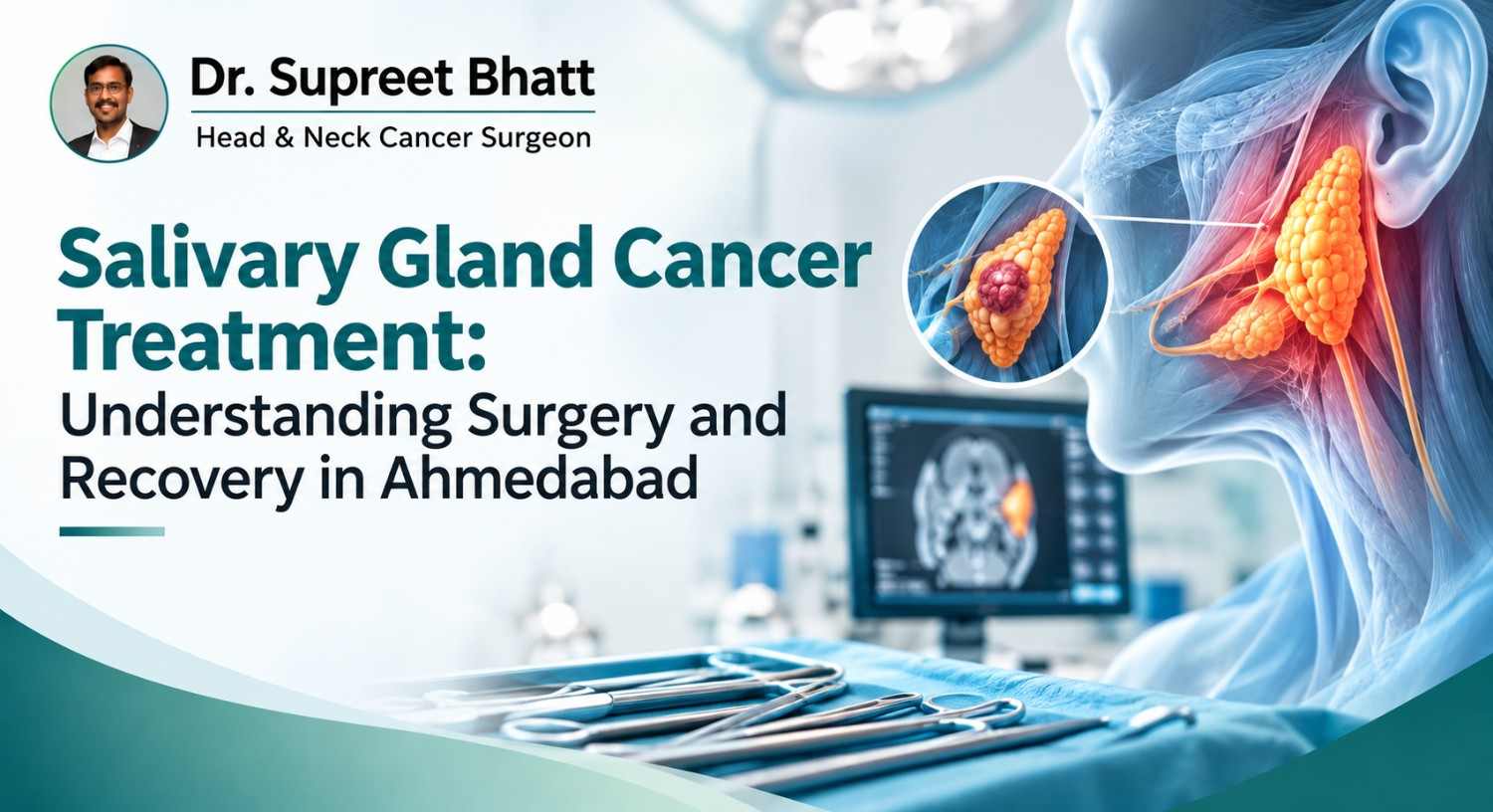
Tumors in the salivary glands can pop up almost anywhere around the mouth, jaw, throat and neck. Most of the time, they're benign, nothing to lose sleep over. But every so often, one turns out to be cancerous and that changes the conversation entirely. It means careful evaluation, a treatment plan built specifically around that patient and a genuine effort to balance two goals at once: controlling the cancer, and protecting the things that make daily life work, a natural smile, the ability to swallow without a second thought, clear speech, normal sensation in the face. Dr. Supreet Bhatt provides specialized head and neck cancer care in Ahmedabad, with a particular focus on the surgical side of treating salivary gland tumors.
If you've landed here because you're researching salivary gland cancer treatment in Ahmedabad, chances are you want to know what actually happens after a diagnosis lands on the table. And honestly, there's no single script to follow. Where the tumor sits, how big it's gotten, what type it is, its grade, how far it's spread all of that shapes the plan. When the cancer is still localized, surgery usually takes the lead. When things are more advanced, radiation, drug therapy, or other procedures often join in.
What Are Salivary Glands?
They make saliva which sounds simple, but saliva is doing a lot of quiet work: keeping your mouth moist, helping you swallow, protecting the tissue inside your mouth, and playing its part in digestion. There are three major pairs:
- Parotid glands, near the ears, along the sides of the face
- Submandibular glands, under the lower jaw
- Sublingual glands beneath the tongue
On top of these, there's a scattering of smaller, minor salivary glands throughout the lips, tongue, palate, throat, nose and other parts of the upper airway.
A tumor can start in any one of these and what kind of tumor it becomes depends on which gland it's in and which cells it grows out of.
What Types of Salivary Gland Cancer Can Occur?
These cancers aren't common, but they come in several distinct flavors, some slow and quiet, others considerably more aggressive.
Mucoepidermoid Carcinoma
This is probably the most familiar name on the list. It shows up most often in the parotid gland, though it can also appear in the submandibular gland or one of the minor glands.
Adenoid Cystic Carcinoma
Deceptive is a good word for this one it can look slow-growing on the surface while still behaving aggressively underneath. It has a particular habit of tracking along nerves, which is why it sometimes brings pain or facial weakness along with it.
Acinic Cell Carcinoma
This one develops from the very cells responsible for making saliva, and it tends to settle in the parotid gland. Generally, it grows at a fairly unhurried pace.
Other Salivary Gland Tumors
Adenocarcinoma, salivary duct carcinoma, squamous cell carcinoma, clear cell carcinoma, carcinoma ex pleomorphic adenoma the list goes on. Because each behaves so differently, nothing about treatment gets decided until pathology has spoken clearly.
What Are the Warning Signs of Salivary Gland Cancer?
More often than not, it starts with a lump that just doesn't go away somewhere around the jaw, mouth, or neck. But symptoms really do shift depending on where the tumor is sitting and how it's behaving.
Here's what tends to show up:
- A lump that keeps getting bigger
- Pain in the face or jaw that won't quit
- Weakness or paralysis on one side of the face
- Trouble opening the mouth all the way
- Difficulty chewing or swallowing
- That unsettling feeling of food getting stuck in the throat
- A burning sensation while eating
- Ear symptoms or drainage that lingers
Not every lump is cancer plenty aren't. Still, if something sticks around or keeps growing, it deserves a proper look from a specialist rather than a wait-and-see approach.
How Is Salivary Gland Cancer Diagnosed?
Good treatment starts with a good diagnosis, and that process usually begins the old-fashioned way, a detailed history and a hands-on exam. The doctor will check the lump itself, the surrounding area, how the facial nerve is functioning, and whether swallowing or jaw movement feels off.
FNAC or Biopsy
A fine-needle aspiration cytology (FNAC), or some other form of tissue sampling, is typically used to get a closer look at the cells in question. From there, a pathologist steps in to determine whether what's growing is benign or malignant and, when possible, exactly what type it is.
Imaging Tests
CT and MRI scans help fill in the picture how big the tumor is, exactly where it sits, and whether it's pressing into nearby structures. This information becomes the backbone of surgical planning.
What Is the Main Treatment for Salivary Gland Cancer?
For most salivary gland tumors that can be operated on, surgery is where treatment starts. The idea is simple to state and harder to execute: take out the tumor completely, while doing everything possible to protect the structures around it. Exactly how that plays out depends on the gland involved, what the tumor looks like, and whether nearby tissue or lymph nodes are caught up in it.
Which is really the whole point behind saying that salivary gland cancer treatment in Ahmedabad has to be built patient by patient, not handed out as a one-size-fits-all procedure.
Understanding Salivary Gland Surgery
Parotidectomy
This is the removal of a tumor from the parotid gland, and it's a procedure that calls for real precision because the facial nerve actually threads its way through this gland, controlling how the face moves.
Surgeons try to preserve that nerve whenever they can, and nerve monitoring is often used during the operation to help track and protect it.
Submandibular Gland Excision
If the tumor is in the submandibular gland, removing the whole gland is often the recommended route. There are several important nerves running close by ones tied to facial movement, tongue sensation, speech, swallowing so this one takes careful planning too.
Sublingual Gland Excision
Tumors here may require taking out the sublingual gland itself. The lingual nerve sits nearby, handling sensation and taste for part of the tongue, so protecting it becomes a real priority during surgery.
Minor Salivary Gland Surgery
These tumors can turn up in the lips, tongue, palate, throat, nose, or sinuses. Surgery generally means removing the tumor along with a margin of healthy tissue around it and the details depend heavily on exactly where it is and how far it reaches.
How Can You Prepare for Salivary Gland Cancer Surgery?
Before surgery, it's worth sitting down and really understanding the diagnosis and what's ahead. Some questions worth bringing to the table:
- What type of salivary gland tumor do I have?
- Which gland is involved?
- Is it localized, or has it spread further?
- What surgery is being recommended, and why?
- Is preserving the facial nerve realistic here?
- Could lymph node surgery end up being necessary?
- Will radiation or anything else be needed afterward?
- What kind of functional changes should I brace for during recovery?
- What rehabilitation might I need down the line?
- How often will I need to come back for follow-up?
Getting these questions answered ahead of time makes it a lot easier to walk into surgery feeling informed rather than blindsided.
Choosing Specialized Care in Ahmedabad
Salivary gland surgery works around some genuinely delicate territory, especially the facial nerve, along with other nerves responsible for sensation, speech and swallowing. That's exactly why specialized head and neck cancer expertise counts for so much, particularly in the more complex cases.
Dr. Supreet Bhatt's practice centers on head and neck cancer surgery and salivary gland tumors, with a strong emphasis on precision surgery and preserving facial nerve function. The broader approach also draws on radiation therapy, drug treatments, imaging expertise, reconstructive support, rehabilitation, and ongoing follow-up care when it's needed.
If you're trying to figure out your options for salivary gland cancer treatment in Ahmedabad, the right path forward comes down to an accurate diagnosis, the specific nature of the tumor, your overall health, and how treatment is likely to affect the functions that matter most in your day-to-day life.
Frequently Asked Questions
1. Is salivary gland cancer curable?
It can be treatable, often quite successfully, especially when caught early and managed the right way. A lot depends on the tumor's type, grade, stage, location, and how it responds to treatment.
2. Is surgery always necessary?
For many salivary gland cancers that can be operated on, yes, surgery leads the way. But it really does come down to the individual case sometimes radiation or another treatment gets added in, or takes precedence, depending on the situation.
3. How long does recovery usually take?
Honestly, it varies a lot, the type and extent of surgery, a patient's general health, and whether more treatment is needed afterward all play into it. Your surgeon will be able to give you a much more specific timeline once they've looked at your case.
4. Can this affect speech or swallowing?
It can, yes particularly if the tumor or the treatment touches structures involved in swallowing, tongue movement, or nearby nerves. Speech and swallowing therapy often gets recommended when that happens.
5. When should I actually go see a specialist about a lump?
If a lump isn't going away, seems to be growing, or comes along with facial weakness, pain, trouble swallowing, or difficulty opening your mouth, that's the moment to get it checked.
Conclusion
Salivary gland cancer calls for careful diagnosis and a plan that's genuinely built around the individual patient. Surgery remains central to treating many localized tumors, though the exact procedure looks quite different depending on whether it's the parotid, submandibular, sublingual, or a minor salivary gland involved. Protecting facial nerve function and the other structures nearby paired with the right rehabilitation and consistent follow-up sits at the heart of good, well-rounded care.
If you're noticing a lump that won't go away, facial weakness, trouble swallowing, or anything else that feels off, don't let it sit too long. For an honest evaluation and a treatment plan built around you, reach out to schedule a consultation with a qualified head and neck cancer surgeon to understand your options for salivary gland cancer treatment in Ahmedabad.

About the Author
Dr. Supreet BhattHead and Neck Cancer Surgeon and Thyroid Surgeon, Senior Consulatent Zydus Cancer Center
View all articles →